Exhibition concept
This exhibition is a phenomenological circuit, designed not to display images, but to deconstruct the very act of seeing. It is built on a simple observation: perception is a computed process. Our minds, like organic pinhole cameras, receive a tiny aperture of sensory data and render a coherent world based on memory and belief. This project seeks to make that internal, mental process tangible.
Titled Phaneroscopy—drawing from C.S. Peirce’s study of the phaneron [the world as it appears]—the exhibition extends this human act of rendering into an external, technological one. It maps a five-year artistic research process in which a core aesthetic is passed through a cybernetic feedback loop: from analog materials [3D-printed cameras, film] through digital processes [live-coded shaders, AI], and back into chemical artifacts [cyanotypes and film]. With each translation, the exhibition critically examines how reality is mutated by its substrate.
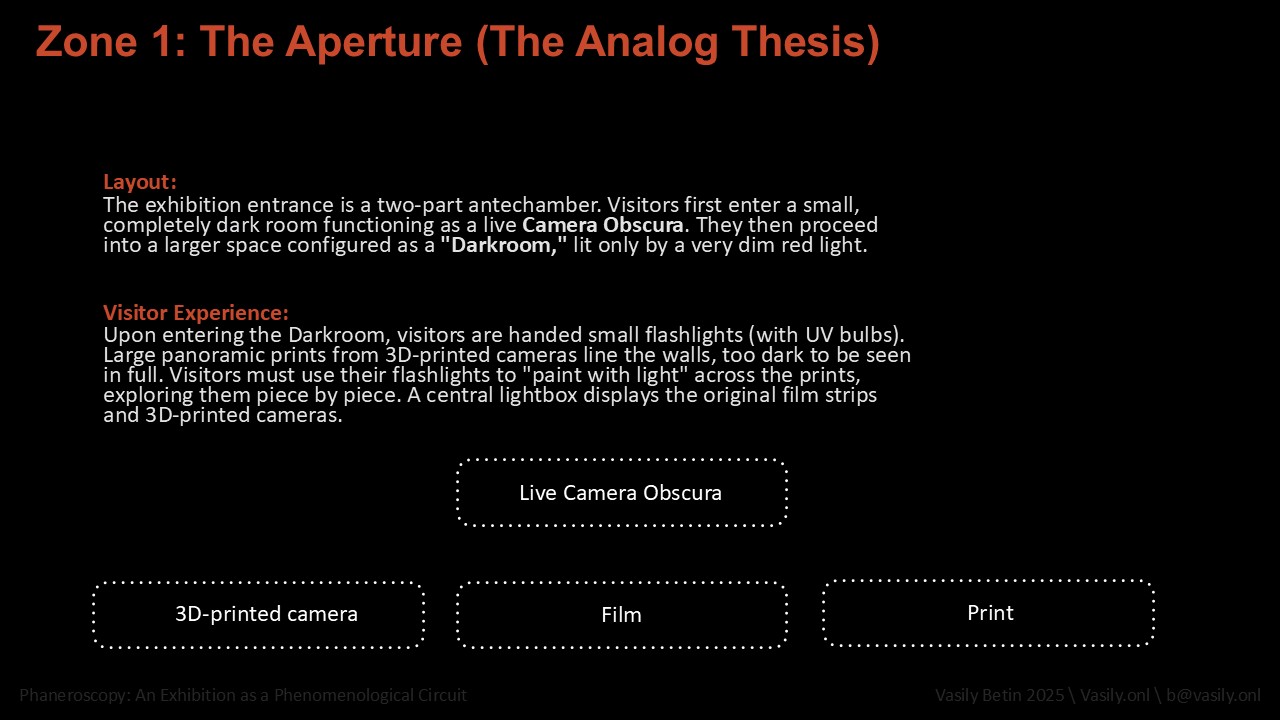
This circuit is not for passive viewing. The visitor is transformed into an active agent, an explorer implicated in the system. They are given tools—flashlights to "expose" prints, analog projectors to operate physically—that make their own perceptual act a central component of the work.
The theme is translation itself—between human and machine, light and chemistry, data and matter. Phaneroscopy is an apparatus for embodied inquiry, a space designed to make us conscious of the complex, technological systems that now constitute the act of seeing
Curatorial Methodology
The design of Phaneroscopy is guided by four key principles that treat the exhibition itself as the primary artistic medium:
To Structure the Exhibition as a Circuit, Not a Display.
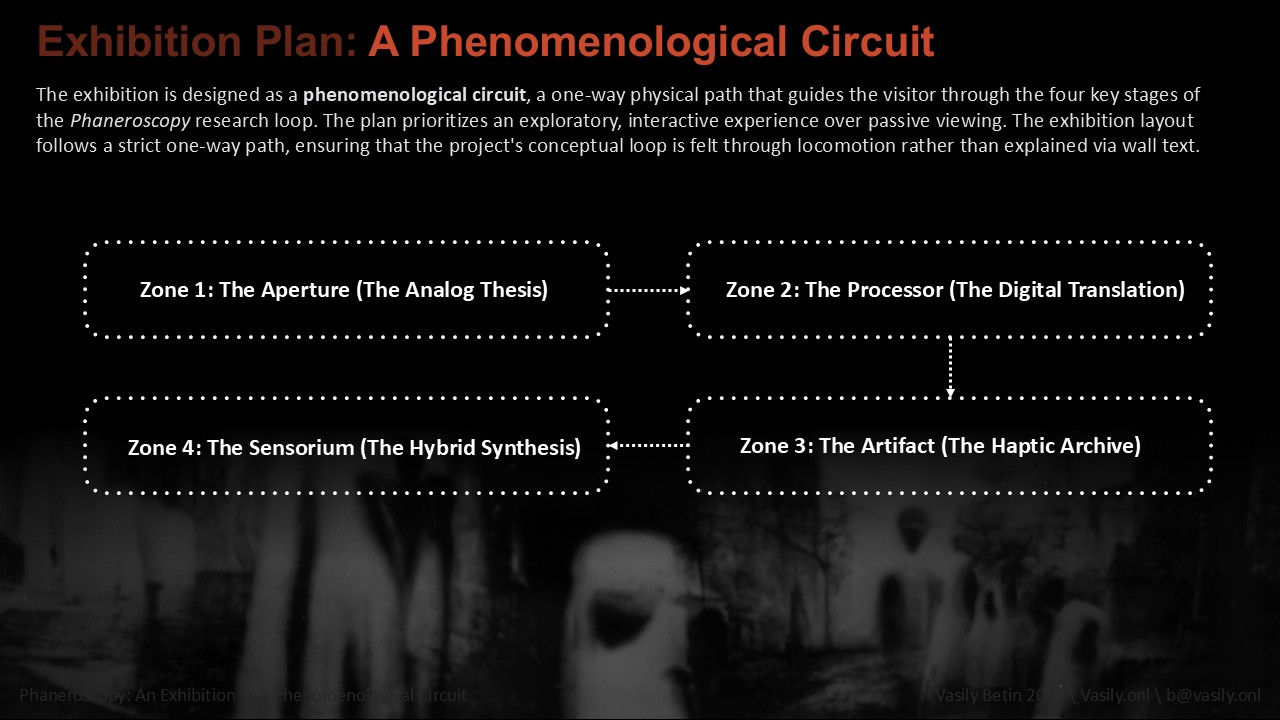
The primary goal is to move beyond the representation of "machine-entangled lives" and instead create a functioning, phenomenological circuit. The visitor's journey physically enacts the work's conceptual loop, transforming the gallery into a space of direct experience rather than passive observation.
To Recast the Visitor as an Active Agent.
By providing tools—flashlights to "expose" images, analog machines to physically operate—the exhibition transforms the visitor from a passive spectator into an active explorer. This method directly challenges the traditional subject-object relationship of the gallery, implicating the visitor in the very act of perception.
To Leverage the Exhibition Form as the Medium.
The visitor's path through the analog-digital-analog process is the central artwork. This structure is a deliberate solution to a key problem in contemporary curating: how to exhibit a durational, process-based research practice in a way that preserves its liveness and complexity.
To Create an Apparatus for Embodied Inquiry.
Ultimately, the exhibition is designed to function as a temporary laboratory. It is a space for visitors to critically and physically reflect on their own modes of seeing, prompting a new consciousness of the complex, technological systems through which we all perceive the world.
Artworks
Mental Imagineering
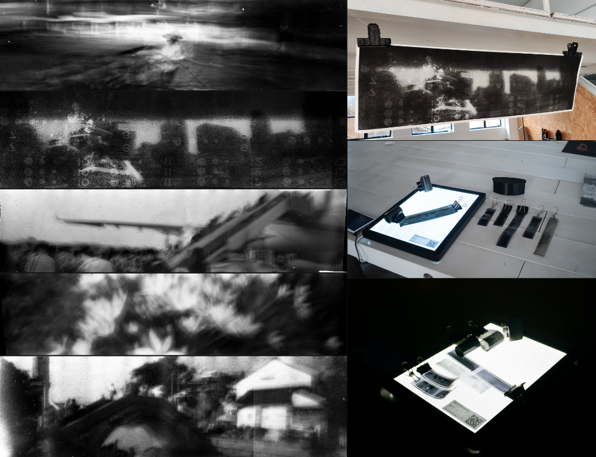
The Mental Imagineering series serves as the foundational analog research for the Phaneroscopy exhibition. The project begins with a core observation: human perception is a computed process. Our minds, like organic pinhole cameras, receive a tiny aperture of sensory data and render a coherent world based on memory and belief. The project's signature, blurry, dark aesthetic embodies this internal rendering.
This body of work was created using custom, 3D-printed panoramic film cameras, with all film developed by the artist. It represents the project's "analog thesis"—a material investigation into the limits of a physical lens. The insights from this hands-on process directly informed the subsequent digital and AI-based explorations in the full Phaneroscopy circuit, serving as the aesthetic and conceptual origin point for the entire five-year inquiry. A virtual exhibition and generative playground for this foundational work can be explored at https://imagineering.vasily.onl/.
The Computational Lens: Live Coding
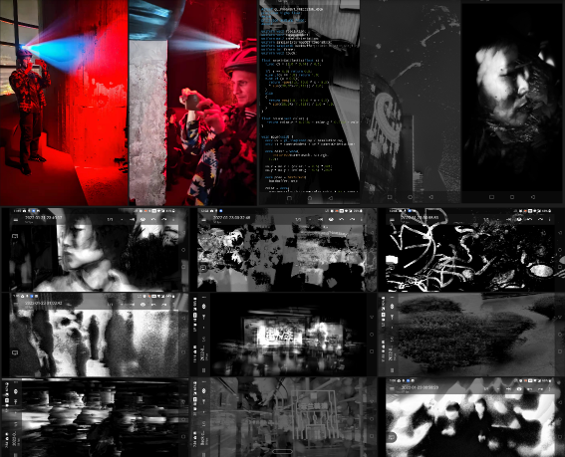
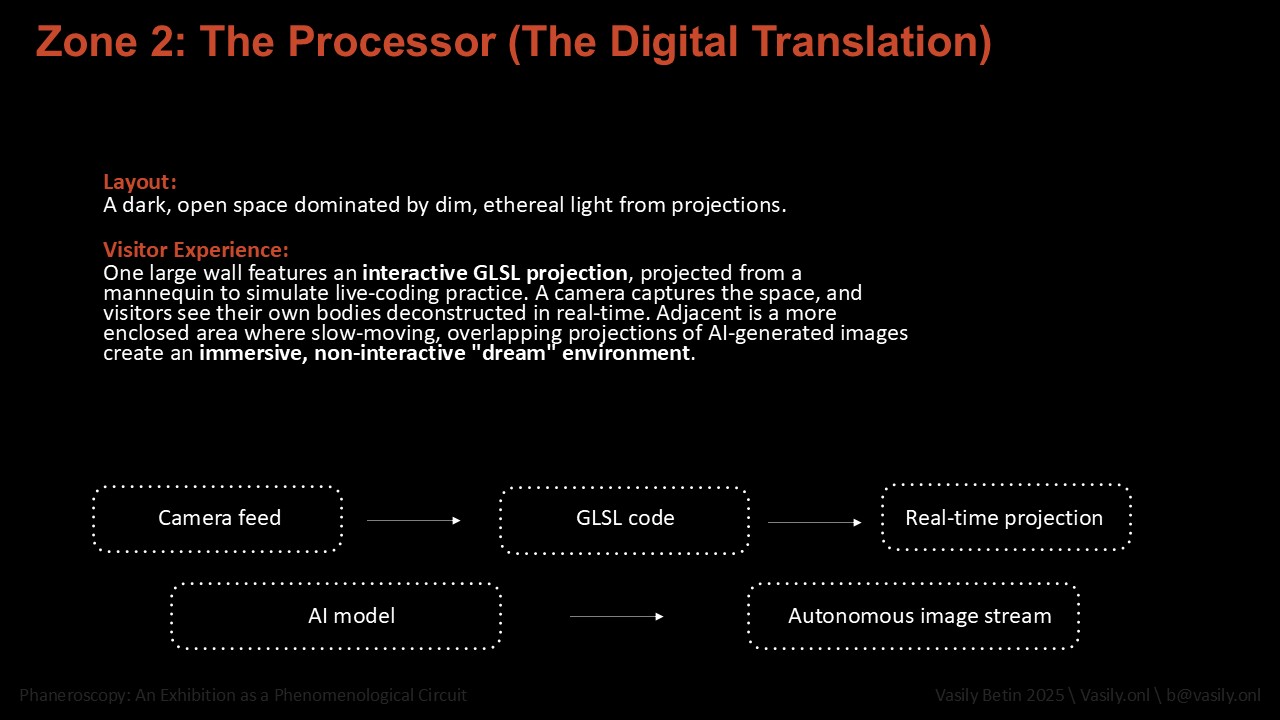
This stage of the research translates the material inquiry of the 3D-printed camera into a live, computational system. Using custom GLSL shaders, the camera of a mobile phone is transformed into a performative, interactive lens. Here, the 'lens' is no longer a physical optic but a mutable algorithm; the aesthetic is not a post-production filter but the direct result of code processing reality in real-time. This process is fully embodied in live performances where a head-mounted projector turns the artist into a walking camera obscura, projecting this computed vision back onto the world.
The shaders themselves are interactive. The final image is co-produced by the camera's input, the code's logic, and the artist's physical touch on the screen, which "exposes" the image over time. This gestural interaction with a software-defined lens is a central component of the Phaneroscopy project, directly investigating the entanglement of the body with computational systems of seeing.
Non-Human Phaneron: Machinic Vision
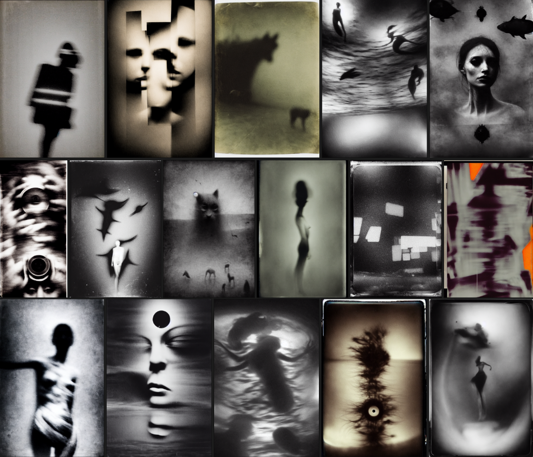
The aesthetic data from the analog and computational studies were used to train a custom AI model, an act designed to teach a machine a specific, limited, and blurry way of seeing. The resulting documents are artifacts of a machinic dream, a visual subconscious that is clearly derived from the artist's language but is also undeniably alien in its texture and logic.
This act of co-creation with an AI is central to the ethical and conceptual framework of Phaneroscopy. The AI is treated as an agential partner, and its output is valued as a unique, non-human perspective. In the exhibition, these images are presented in an immersive, non-interactive projection, emphasizing their status as an autonomous stream of machine-consciousness.
The Analog Return: Film as Forensic Evidence
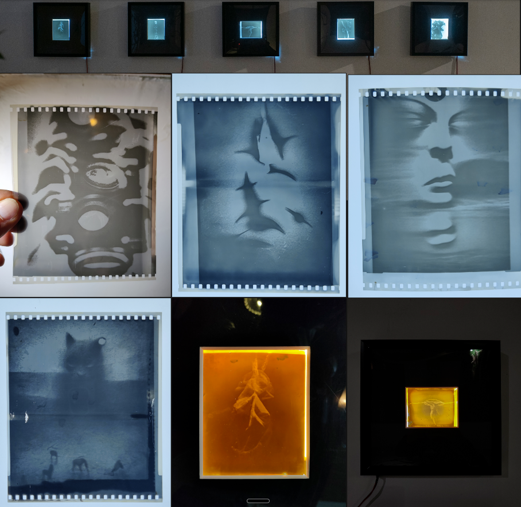
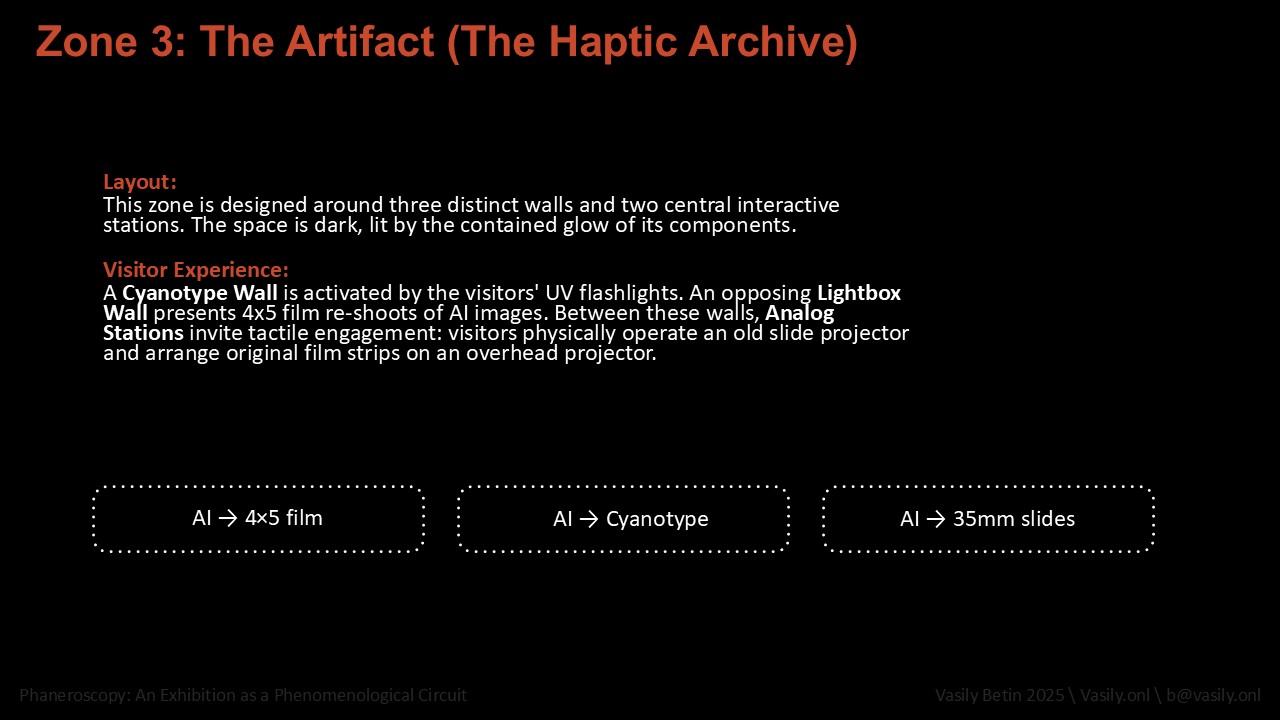
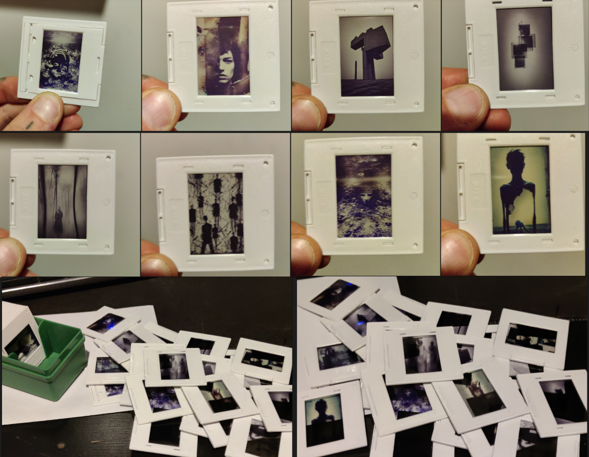
This stage completes the first phenomenological circuit by forcing the AI’s immaterial vision back into a physical, chemical substrate. The digital outputs from the Machinic Vision study are transferred to 4x5 film. This act of translation is a critical inquiry into the ontological status of the AI-generated image. When rendered in silver halide, the "perfect" data of the machine is subjected to the grain, chance, and potential decay of the analog world.
Presenting these films in lightboxes transforms them into singular, auratic objects. The light passing through the emulsion reveals a depth and texture that a screen cannot replicate. This process is not a reproduction; it is a critical re-materialization, an act of "reverse-scanning" that grounds the posthuman inquiry in the history and materiality of photography. It stages a direct dialogue between the newest and one of the oldest forms of image-making.
The Analog Return: Cyanotype Time Machine
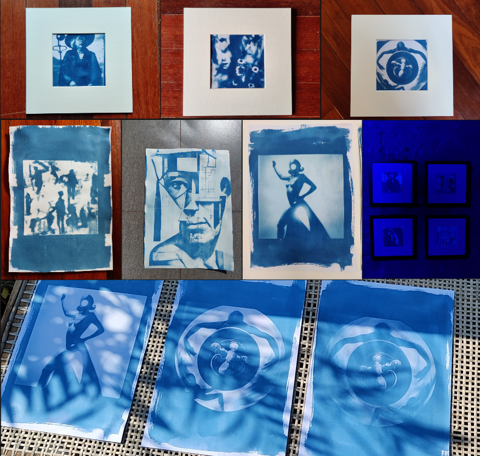
This series represents a further de- and re-materialization of the AI's vision. Digital negatives of the AI-generated images are used to create cyanotypes, a 19th-century photographic printing process. This act of "anachronic translation" forces the imagery of a cutting-edge neural network into one of the earliest and most elemental forms of chemical photography, creating a temporal dissonance.
The prints are not just objects but interactive surfaces. In the proposed exhibition, a low-power ambient UV light gives them a faint glow, but they are fully "activated" by the visitor's handheld UV flashlight. This interaction allows the visitor to "charge" the Prussian blue pigment, making the machine's vision blaze forth from the paper. This performative act of revealing the image makes the visitor a participant in the work's final exposure, connecting the digital present to the chemical past through a gesture of light.
The Analog Return: The Haptic Archive
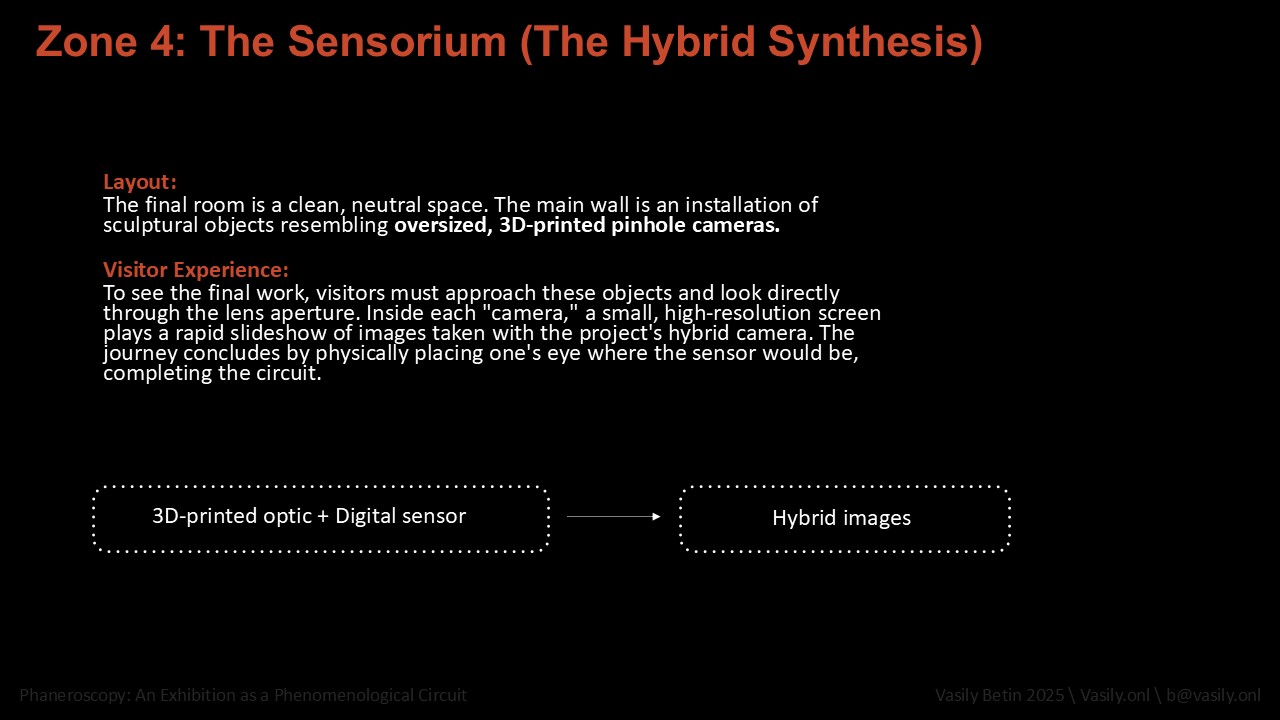
The Hybrid Sensorium: A New Lens
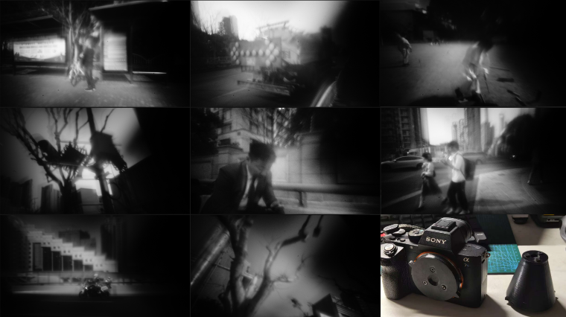
This body of work represents the synthesis of the Analog->Digital->Analog research loop: a new, hybrid sensorium for capturing the everyday world. The apparatus combines a computationally fabricated, materially constrained analog optic (the 3D-printed lens) with a high-sensitivity digital sensor. The resulting images carry the "limited perception" aesthetic of the original pinhole experiments but are augmented with speed and detail only possible with modern digital technology.
In the proposed exhibition, this extensive archive of over 5,000 images serves as the basis for "The Sensorium," the final interactive zone. Visitors will look through the apertures of oversized, 3D-printed camera sculptures to view a rapid, looping slideshow of these images on embedded screens. The act of viewing completes the phenomenological circuit, placing the visitor's eye where the sensor would be, inviting them to look through a new kind of pinhole and experience the world through a fully synthesized, posthuman lens.
Exhibition Plan